Showing posts with label casino royale. Show all posts

Friday, July 6, 2018

There Is No Substitute: Martin Campbell's Unique Approach to James Bond

Martin Campbell with Famke Janssen and Pierce Brosnan on the set of GoldenEye

The choice of Martin Campbell as the director of two James Bond films was much more than the assured success of in the return of a very popular fictional character. GoldenEye and Casino Royale are not just the introduction of two different actors in the leading role, but very good films and classic on their own. The quality of these two movies has rarely been surpassed in the series and the visual impact of these productions gives the audience the feeling of being blended into the plot. The luxury world that Ian Fleming utterly described on his books is thoroughly adapted in both Campbell movies and, thanks to many cinematic resorts, it feels as equally rich as the one Fleming described.

When James Bond returned after a six year and a half hiatus to the theaters in 1995, he had to prove he was there to stay. GoldenEye had to be much more than a very good action/adventure film to ensure audiences that Bond was still relevant for the new millennium and to establish Pierce Brosnan as a strong leading actor in the role.

EON Productions took notice of Martin Campbell's talents as a director after the success of 
the ecological thriller Edge of Darkness in 1985 and the sci-fi adventure No Escape in 1994, which proved that Campbell was not only the right man for the job, but that he could deliver an artistic tour de force for the much awaited return of 007.

While John Glen brought solidity on the previous five Bond films starring Roger Moore and Timothy Dalton, Campbell and his crew delivered a unique, rich and dramatic take on Pierce Brosnan’s first 007 outing, taking every possible advantage of the cinematic experience a Bond film could offer.

GoldenEye: the leader of Janus reveals surfaces from the shadows to reveal his true identity -Alec Trevelyan, former 006- to a shocked Bond. Supreme quality chiaroscuro techniques by DP Phil Méheux.


GoldenEye: breathtaking opening shot of the movie showing the Verzasca Dam in Lugano, Switzerland. It doubled for a part of a Chemical Weapon laboratory in Archangel, USSR. 

Trough behind-the-scenes footage and interviews, it’s easy to notice how the New Zealand-born director has taken the job very personally and put all of his energy and mind on the film, with seven days schedules that went from four in the morning to late in night. He has also been supervising every little detail that would go unnoticed to any other filmmaker.

 Overall, the Martin Campbell movies are all about the details. While the text, the dialogues of his films are outstanding, the first notion Campbell transmits on his films is that the action speaks a lot: it takes a single blow with a towel and another quick judo jab to establish Brosnan’s Bond as a trained, professional government agent who leaves an attacking assailant unconscious (or most likely dead) as he tries to attack him from behind on the Manticore yacht. "When Brosnan kills, he kills very hard and fast. I made all his actions very economic. One punch does it. It's just very simple and economic, no fussiness. I made him stand still a lot,” he commented.

GoldenEye brought back well-choreographed fighting scenes into the series that harkened back to that memorable Orient Express fight between Bond and Grant in 1963’s From Russia With Love, something he wanted to deliver to the character with Sean Connery’s Bond on mind. Take the 007 vs 006 scene in the antenna in Cuba, where you have the feeling that both men want to see each other dead in the most brutal way. Of course, this effect was achieved also by the sharp editing of Terry Rawlings, very reminiscent to John Glen’s fast-paced editing of On Her Majesty’s Secret Service.

When Bond isn’t fighting, he’s living by the highest possible standards. Campbell knew it was hard to bring back the apparently outdated James Bond in a world and a time where action heroes were the Bruce Willis and Arnold Schwarzenegger types. Instead of adapting Bond to this kind of heroes and their stories, Campbell noted that one thing those screen action supermen lacked the sophistication of 007 and that precisely was the key of his success, offering GoldenEye “as a window for that kind of hero.”

GoldenEye: Bond reflects on his future confrontation with his former friend, Alec Trevelyan, on a Cuban beach as Natalya approaches him.
GoldenEye: Bond kisses Natalya in a cuban beach. Courtesy of editor Terry Rawlings, the image cleverly fades into the burning fire of a hearth showing the passion between the two.

With his longtime collaborator cinematographer Phil Méheux, Campbell gave the film a unique look, much more atmospheric and dramatic than ever before. This was very important to differentiate Bond’s style from the blue collar heroes around. While these men’s scenarios are the dark alleys and urbane settings, Bond’s playground is on a luxurious hotel and in exotic spots such as Monte Carlo or the Caribbean. Following the orders of Campbell, Méheux offered eye-popping visuals of the Manatí beaches in Puerto Rico (you’d never think there was a dumpster there behind the lens of the camera!) or the Principality of Monaco at night, where a tuxedoed Bond parks his Aston Martin DB5 before some gambling in the famous casino, brilliantly replicated by Peter Lamont on the Leavesden studios.

The color palette of GoldenEye was rarely surpassed in future Bond films. Bond’s encounters with Trevelyan are a good example of that as the ally-turned-enemy emerges from the shadows twice: when he first meets his friend at the Archangel facility he’s covered by the dark until a shade of light reveals him as a good guy, Bond’s ally and teammate. Later, in the statue park, he comes out of the shadows again until the light reveals him as Janus, the treacherous crime syndicate leader holding a grudge to Bond and England. These brilliant chiaroscuro techniques of Phil Méheux helped to bring a special mood to the tone of the story and the meaning of each location. The facility, the statue park and the interrogation cell of the Russian military archives have this treatment.
GoldenEye: Bond and Natalya are interrogated by Mishkin at the Military Archives. Once again, the chiaroscuro techniques help to create the appropiate effect.

GoldenEye: Bond meets Xenia at the Casino de Monte Carlo, whose interior was recreated at Leavesden Studios. Notice the blend between the gold and red hues on the background to emphasize luxury.


In contrast, the casino scenes are “painted” with gold, red and brown gammas and the Monte Carlo harbor scenes in blue tones so we can get the sense of being in a coastal and vocational region of the world. For the scenes in Cuba, where Bond and Natalya seal their love, warm orange tones with deep green flora and black shadows helped to create the feeling of the hot Caribbean and to spread into the screen the “warmth” between the leading couple. It was not a coincidence that their kiss fades into the burning fire of a hearth, courtesy of the creativity of Terry Rawlings.

This attention for the details, as important as the dialogues and portrayal of the actors, makes GoldenEye a very visually strong movie where even the unbelievable is believable.
In 2006, the reboot of the franchise called for the introduction of a new actor in the role of James Bond and Martin Campbell was asked to helm the first official cinematic adaptation of Casino Royale, with Daniel Craig in the leading role.

Being the genesis of the character, the James Bond introduced here would be different from Brosnan’s style and much closer to the humorless Bond of the Ian Fleming’s novels. Casino Royale’s Bond had to be much darker and psychologically complex than his self-assured predecessor, and the overall tone of the film also had to be that way.

Casino Royale: a pre-00 Bond meets Dryden, the corrupt Head of Section M marked for death. This scene was shot in black and white film by Phil Méheux to take an unique approach to reintroduce a rebooted 007.


Casino Royale: a pastel palette is prominent as Bond arrives to Nassau to follow the lead left by a bomber he eliminated in Madagascar.

In contrast with GoldenEye, Casino Royale is not escapist at all. The story is crude and realistic and the new rebooted Bond has to play with all his wits, get hurt both physically and emotionally before achieving his objective. We see our hero bleeding and getting bruised much more than before, and one scene particularly stands out where 007 looks at him in the mirror as he drinks a glass of whisky minutes after strangling a man to death with his biceps.

The preceding scene, where Bond and lord of war Obanno have a cruel fistfight on a hotel stairwell, has the same intensity as the Bond vs Trevelyan fight at the end of GoldenEye, where the audience can feel they’re both facing dangers and could die at any moment. The scene looks expensive and –once again- the frenetic close shot editing –this time by Stuart Baird, from The Legend of Zorro- brings back vibes from On Her Majesty’s Secret Service.  

Casino Royale: A helpless Bond is about to be tortured by Le Chiffre. The obscure setting with a few shades of light is what the scene needs to build fight and tension to the viewer, sympathising for Bond.

Casino Royale: James Bond finds out his Vodka Martini has been poisoned. A close up to  Daniel Craig looking at his drink achieves the desired effect. The casino atmosphere is still mantained with the gold background.

In the same way that GoldenEye reinvigorated the series after five somewhat repetitive Bond films in terms of style, Casino Royale brought fresh air after the three last action-hero type films of Brosnan in the role. Ian Fleming’s 1953 character was now adapted to a world surrounded by technology and with the international terrorism hanging like a shadow after the 9-11 attacks.

While Bond wouldn’t directly fight these fundamentalists, Le Chiffre, the Soviet Union treasurer in the original novel, became a banker for worldwide terrorists and African warlords whom Bond would have to face in the poker tournament the man is hosting to recover the clients’ funds he spent speculating in the stock market.


As much darker this James Bond had to be, the film isn’t without humor and style. If in 1995 Bond had to be an alternative for the blue-collar heroes like Mel Gibson or Bruce Willis, in 2006 he had to be an alternative for the likes of Jason Bourne or Chirstopher Nolan’s Batman version. And the alternative was based, once again, in the style of Bond – a very different style from the other heroes. Campbell insisted that not everything had to be changed and, while Daniel Craig’s portrayal was offering a much more grittier and muscular Bond than before, he would still move in the same exotic world, wear the same elegant suits and live in the same world of luxury everyone would desire to be.

Casino Royale: Bond tries a home-made emetic recipe to counteract the effects of the poison. The white, blurry lighting Dutch-Tilt shot by Phil Méheux and Stuart Baird's dynamic editing make the scene believable.
Casino Royale: After his ordeal in the hands of Le Chiffre, Bond is being taken care by Vesper Lynd. Green, a color associated to peace and hope, is prominent in this shot.

Casino Royale starts with a grainy black and white introductory scene, but as Bond accomplishes his two assassination missions and is promoted to 00 status, Phil Méheux uses every possible resort to give the film an unique glossy quality where the palette of colors give the scenes their proper mood: the freerunning chase in Madagascar is given an orange filter to give the sensation of hotness, the confrontation between Bond and a bomber in the Miami Airport is given a static blue gamma to make it look colder and darker and, once again, the casino scene is a mixture of black, gold, brown and green to emphasize the richness of the place Bond is playing, which is not any casino but a high stakes gambling spot where few people can be. For the ending scenes in Venice, the screen is filled with green, blue and white in the scenario, giving it a sort of Renaissance sculpture feeling. It is noticeable how James Bond recognizes Vesper Lynd for her distinctive red dress, different to what everyone else was wearing in that scene.

The highest point of creativity would probably be the scene where the secret agent is poisoned by Le Chiffre during the card game. As Bond goes to the bathroom, a bright and somewhat blurry white filter makes the audience feel the same dizziness Bond is feeling. Martin Campbell made sure this scene feels as realistic as possible with the artistic view of Méheux and the sharp techniques of Stuart Baird to create a unique and substantial effect.

Between the 11 years that separate GoldenEye from Casino Royale, Martin Campbell has refused to direct any other Bond film even after being asked to return. He claimed he didn’t want to repeat himself, and looks like a very conscious decision on his behalf considering his return was very welcome in 2006 and helped to calm –or silence– those who were with doubts about the success of Casino Royale. Both films occupy the number one place on many fan lists and are regarded as generational classics for many moviegoers.

Unlike the Archangel mission from GoldenEye, where half of everything was luck and the other half was fate, when it comes to a Martin Campbell movie nothing comes out of luck or fate. It’s a matter of talent, passion and experience. 

Nicolás Suszczyk


Tuesday, June 26, 2018

Je t'aime, mon Québécois: Revisiting 'Allied'


There are no doubts that Robert Zemeckis is one of the most talented filmmakers ever. In more than one film he manages to touch the most unreachable strings of anyone's soul, giving the audiences the lowest emotional blows that no emotionally strong alpha male could ever resist. 2016's Allied is certainly not an exception as the story revolves in one of the world's darkest hours: World War II, when Europe was cornered by the deadly Nazi forces and the Luftwaffe dropped bombs all over England.

Theatrical poster for Allied.
It all began with a screenwriter Steven Knight remembering a story he heard when he was 21 years old, about an Allied officer marrying the female agent he had to work with. A time after their son was born, his superiors ordered him to kill her with concrete evidence that she was a German double agent.

This was the basis of Allied, where Canadian RAF commander Max Vatan (Brad Pitt) is sent on an assasination mission in the French Morocco, where he meets his liason Marianne Beausejour (Marion Cotillard), posing as his wife until the mission is accomplished. At first, they'll resist falling for each other, but the physical and emotional connection between the two will grow significantly after they get the job done and miraculously escape alive.

Years later, after Max and Marianne marry and have a daughter, he is summoned by Section V of the Secret Intelligence Service and told that Marianne Beausejour was dead and replaced by a woman looking very much alike, and that their target in Morocco was actually a Hitler dissident. Max is ordered to run a "blue dye" on her: leave a fake important message to see if she reports it to Germany. If she does, he'll have to kill her or they'll be both executed for treason.

The story is also very reminiscent to the very las pages of Ian Fleming's Casino Royale, where Bond discovers his very much beloved Vesper was a double agent after she commits suicide not bearing with the guilt and the posibility they could both be hunted down. In comparison, Allied extends that premise by having Max presented with the facts and having to act, standing on a crossroad between the flag and the woman he loves.


While Brad Pitt feels a bit unemotional on his performance as Max, Marion Cotillard makes an exceptional role. Perhaps one of the best of her career. The French actress is incredibly convincing as both a cold and self-reliant agent of the French Ressistance and as the caring and loving wife every man would dream of. Despite the cloud of doubt floating avobe the loyalties of her character, it's hard not to fall for her and not to feel her every time as much as his husband does. She was, without a shadow of doubt, the right actress for the role.
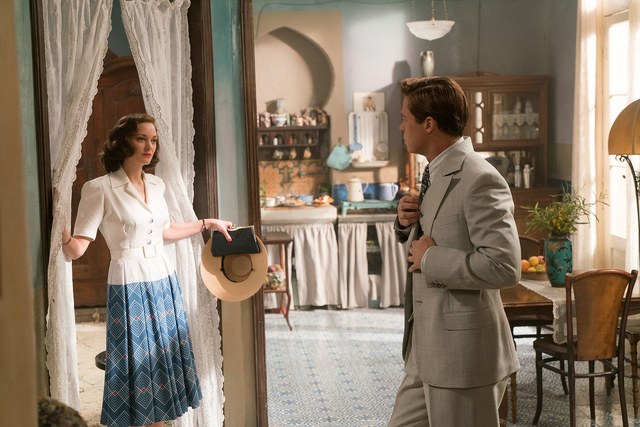
Marianne (Marion Cotillard) and Max (Brad Pitt) in a scene set in Casablanca in the fiction.
The detail of the production design by Gary Freeman and the costumes by Joanna Johnston is outstanding.

"C'est moi. This is the real me," she tells Max as she hugs him in tears, while she's giving birth to their daughter Anna in the middle of an air-raided London.


Robert Zemeckis brings back the glory of his Forrest Gump days with this movie: the soundtrack -also by Alan Silvestri- has the same emotional charge as the one of the highly acclaimed 1994 film. A good mixture between the soft wind instruments underlining the ill-fated romance between Max and Marianne and the intense and fast percussion cues of the war scenes. The setting of the movie in the 1940s was also very detailed: Marion Cotillard's costumes designed by Joanna Johnston resembled the times with very chic designs, so was Brad Pitt's black tuxedo and cream three-piece suits, very suitable for the hot climate of Morocco.

"The movie is a romance at its core, so the production design was always done with an eye towards being romantic", commented Zemeckis. "When we start the film in Casablanca we wanted it to evoke the Casablanca that we know from the movie Casablanca".

The happy days of Max and Marianne.


Production designer Gary Freeman took attention to every detail to turn the Moroccan city into a North African version of the French Riviera as it was during the days where Morocco belonged to France. It is with the great team work made by Freeman, Silvestri and Johnston that we fall in love with an exotic and romantic story right from the very beginning: the people in charge of the set design, the soundtrack and the costume design succeed in making the film beliavable, sexy and intense.

As the story moves to London, the costumes and sets change to provide a darker related to the days of Wartime. The Special Operations Executive office were based on Winston Churchill's claustrophobic offices inside a bunker and the cottage where Max and Marianne live has small rooms as it was fashionable back then. Gary Freeman often used the same location or building to prepare three different sets, and the changes went unnoticed.

The same happened with Marianne's clothing, which are much opaque incomparison to her colorful costumes from the Moroccan scenes. And the cinematographic palette offers an abrupt change between the gold and red hues of the desert and nightclubs to the desaturated colours of the Wartime London, showcasing Max's inner feelings as he is facing the posibility that his wife may be betraying him and his country.

Allied is a masterpiece, a movie that seduces and makes you cry. It can be defined as a war film, a drama or a romance, with the balance inclined much more towards the latter. A story on how could true love prevail over war. On how true love could prevail over masquerades, betrayals, deceit and even death.

Nicolás Suszczyk


Thursday, May 24, 2018

'Forever And A Day' review: 007 is Dead, Long Live Bond


While the cinematic James Bond is doing some silence, the literary James Bond is back. Altough, in this case, we could say he's back... in time! Anthony Horowitz second Bond novel Forever And A Day is a prequel to Ian Fleming's Casino Royale, which introduced the British secret agent to the world, marking the beginning of a timeless legacy.


(Mild spoilers below this point)

Taking place around 1950, one year before the events of the first Ian Fleming novel, Forever And A Day begins with the death of 007. But don't worry, altough this 007 wears Saville Row suits and was a very much regarded agent by M, he's not James Bond. The anonymous 007 has been sent to Marseille to investigate the surprising stop on the narcotic production. The region is a battlefield between the Corsican and Sicillian gangs because of the drug business, so the Secret Services tought someone could be planning something bigger and they sent 007 to survey the French Riviera underworld. There are little leads and no explaination on how the secret agent was unarmed when he was shot at point blank at La Joliette, unarmed, on daylight. There are also no clues on his research, except that he made contact with one Madame 16 or Sixtine, a rogue agent that went freelance selling secrets after being captured and tortured by the Germans during the war. So far, Madame 16 seems the prime suspect of 007's death.


Vintage postcard featuring the Casino de Monte Carlo, where Bond has his first encounter with Madame 16

M resolves to send someone to replace the deceased agent. 008 is recovering in the hospital. 0011 is on a mission in Miami. The head of the British Secret Service turns his eyes to a new recruit, the operative next in line for the 00 section, a man recommended by the Chief of Staff: Bond... James Bond.

Taking the place (and number) of 007, who was a close friend of his, James Bond goes to France and in the following chapters he'll have to face many exhilarating dangers: an infiltration on a film processing plant (used for dark purposes) in the middle of a forest filled of bobby traps, the escape from a sinking luxury yacht rigged with explosives, a downhill escape on jeep and a heroin-based torture. Of course, the perks of his job will also allow him to visit the Casino de Monte Carlo for a Blackjack match against the pretty Madame 16, that will turn out to be a rather memorable woman in Bond's life.

Forever And A Day has -like Trigger Mortis- original Ian Fleming material as the main source, in this case is the TV serial pilot Russian Roulette. The narrative of this book is rather similar to the one of its predecessor, too: very straightforwarding and short in descriptions, but with some subtleties that make it an enjoyable read. In this novel we learn, for example, how Bond started preferring the Morlands cigarettes and why his Martini should be "shaken, not stirred". The second chapter also describes, in full detail, how he eliminated the Norwegian man that spied for the Nazis during World War Two. While the James Bond of Forever And A Day is around 30 years old and a recently promoted 00 agent, he's very smart and definitively not less lethal than Fleming's Bond.


Horowitz deserves a lot of credit for this novel, considering the fact that precedes Casino Royale and every other James Bond novel. The challenge is huge: with the 1953 book defined as the one where Bond went trough emotional and physical hell in the hands of Vesper Lynd and Le Chiffre, the one that shaped him up as the one we know, a precuel for Casino Royale had to be carefully written in order to avoid overshadowing the important characters that meant so much for the secret agent. The girl and the villain can't be emotionally more important than Vesper or Le Chiffre or what Fleming had created would seem fake. 


The French Riviera, where agent 007 was shot dead in mysterious circumstances


At the same time, the elements in Forever And A Day shouldn't be completely weak and uninterested. Yet, the author managed to balance the elements in an exemplar way: the villain, Corsican gangster Jean Paul-Scipio, makes the new 007 feel very uncomfortable during his stay putting him in perilous situations. On the other hand, and despite her protagonism goes a little over the top near the climax where she almost opaques Bond, Sixtine proves to be a very well written character as an experienced agent 10 year older than Bond. She's smart, resourceful and with epic characteristics. Of course she wasn't meant to be over Vesper when analiyzing Bond's life, yet one has the impression he will never forget this girl.

A story of death, betrayal and brutality, Forever And A Day also provides good quantities of elegance and romance (the title itself, as read in the book, has a romantic connotation). At the same time, the action feels very "cinematographic" in a way and there are some elements that are reminiscent to the movies, with a plot somewhat similar to Live and Let Die and Licence to Kill, and some very tiny nods to GoldenEye and Tomorrow Never Dies. The exotic locales are an effective setting for the story, and the fact that the book is set in the 1950s gives it a special touch: the French Riviera, a sunny turistic spot darkened by the occupation of the Corsican and Sicilian gangs, fighting each other for the drug business and using the beautiful locale as a battlefield.

Forever And A Day is a good pre-introduction to the literary James Bond in the same world of intrigue, violence and elegance Ian Fleming created for his hero. Everything in the right balance to avoid overshadowing Casino Royale, but bringing up an exciting product in terms of narrative -and bondian- quality.


Leer artículo en español (bondenargentina.tumblr.com)


Nicolás Suszczyk

Monday, November 20, 2017

The Swinging Bonds of 1967 - Too much (in common) for one James Bond!


The “Swinging London” waves threw barrels of color to the grey streets and society 50 years ago, in 1967. During that year, as Pink Floyd, Jimmy Hendrix and The Beatles were heard loud in music stores and Twiggy was photographed everywhere, the regular moviegoer had not only James Bond film offered to him, but two.

For the first time –sixteen years prior to 1983’s “Battle of Bonds”– two different adaptation of Ian Fleming’s character would face each other, both bearing big discrepancies but a few things in common.

On June 12, You Only Live Twice was released. For the first time in the official 007 series produced by Albert R Broccoli and Harry Saltzman, a great departure has been made between the script and Fleming’s original novel, consisting in a dark and dramatic story where a depressed Bond was out of revenge for the death of his wife against Ernst Stavro Blofeld, leader of SPECTRE. In the 1964 book, the secret agent follows the lead to one Dr. Shatterhand, owner of a suicide garden in Japan. The doctor is revealed as Blofeld in the last chapters, and his plan doesn’t go beyond attracting “dishonoured” Japanese citizens to commit suicide.


Two months before this film, Columbia Pictures released Casino Royale, an adaptation of Ian Fleming’s first Bond novel. American producer Charles K Feldman acquired the rights of this novel some time before Broccoli and Saltzman. Since the duo refused to join forces to produce the movie, Feldman went solo and opted to satirize the contents of the novel. The 1953 book was a dramatic story that included a horrid torture scene and a tragic ending, where the girl whom the protagonist falls for reveals to be an enemy agent and commits suicide afterwards.

You Only Live Twice poster artwork by Frank McCarthy, depicting 007 walking upside down the villain's lair inside a volcano. A image that promises limitless andventures and thrills.

As the Space Race was at its height, with astronaut Ed White performing the first US spacewalk in the Gemini 4 mission, You Only Live Twice screenwriters Roald Dahl and Harold Jack Bloom oriented Blofeld’s plan to a blackmail that included the hijacking of space rockets in order to “inaugurate a little war” between the US and the Soviet Union, both powers challenging each other for the Space Race since the late 1950s.

Dahl was known for his children stories like Matilda or Willy Wonka and The Chocolate Factory, Bloom for TV series like The Man from U.N.C.L.E. and Bonanza. Scribes with this kind of background lightened the story in a significant way, providing the SPECTRE organization with an enormous lair hidden in a volcano (it costed one million dollars, the budget of the first Bond film Dr. No), explosive action sequences, and lots of humoristic situations for Sean Connery’s Bond.


Casino Royale poster artwork by Robert McGinnis. The
psychodelic tatooed lady invited the audience to a
world of extravagant action and beautiful ladies
The usual quota of beautiful women was also exploited with three main female characters (the good girl who dies, the bad girl who also dies, and the one that remains with the hero, according to Dahl’s formula) opposing the romantic Kissy Suzuki from the book, who tries to retain Bond in the last chapter when he loses his memory after a fiery battle with the villain.

Unlike the Lewis Gilbert film, whose only big problem was Sean Connery getting tired of the James Bond image and the Japanese fans and reporters stalking him even in the bathroom (literally), the production of Casino Royale was far more complicated.
Five directors helmed the film: John Houston, Val Guest, Robert Parrish, Ken Hughes and Joe McGrath. None of them knew what the other was shooting. The stars had a volatile relationship with each other, namely Peter Sellers who refused to work with Orson Welles, kept making a change after another in his scenes, and had some arguments with his co-star and fiction lover Ursula Andress.

All the dramatism of Ian Fleming’s novel was of course left aside to make a spy spoof. The story, written by Wolf Mankowitz, had the retired Sir James Bond played by David Niven (one of Fleming’s favourite actors for the role of his creation) visited by the head of the world’s biggest intelligence services, begging him to return to active field after a mysterious enemy has killed most of their agents. The fun starts as Sir James differentiates himself and criticizes “the bounder” who got his name and number and complains of the overuse of gadgets in the service. This is of course an indirect to Connery’s official Bond, who is “an impostor” in this world.

David Niven as Sir James Bond in Charles K Feldman's
Casino Royale. Niven was Ian Fleming's idea of an
onscreen Bond, but this clearily wasn't the version
he expected.
Suddenly, Sir James’ house is blown away and M dies on the attack (actually, it was M’s plan to blow James house away, to force him to return). After meeting M’s widow Lady Fiona and a number of teenage girls trying to seduce him –whom, unlike what the official Bond would have done, he rejects– he plans to train a number of male and female agents and name them all “James Bond 007”, to distract the enemy. The big threat was none other than Sir James’ nephew Jimmy Bond (Woody Allen), plotting to kill all men over 1.60 mt and make all women beautiful with a bacillus he created.

Only the name of a few characters and the card game (held between Le Chiffre and Evelyn Tremble, a baccarat expert recruited by Sir James) remain from the book. Instead, Casino Royale preferred to take full advantage of the colourful era with its ravishing cinematography, over developed costumes and bombastic music by Burt Bacharach, all in a film made with the spirit of the Pink Panther saga and almost following the structure of What’s New Pussycat, a prior Feldman production also starring Sellers and Andress.

Casino Royale should be remembered more as the testimony of a funny 1960s film than a James Bond film, but You Only Live Twice stands out as a solid James Bond movie as produced by EON and tied up to the official franchise. The difference is very clear in that aspect, with only reading a plot summary of both flicks.

However, the Lewis Gilbert movie also stands out in comparison of the first four official Bond films. Far from the simplicity of Dr No and From Russia with Love, closer to Goldfinger’s escapism and taking one step ahead of Thunderball’s lavishness, this movie broke new ground as the fantastic comic book-like situations in the series (three girls, action scenes, gadgets, villain and henchmen in underground lair) began to soar from this film on in the series.

"The things I do for England!" - Bond is seduced by the deadly SPECTRE agent Number 11 aka Helga Brandt (played by the late Karin Dor). Following Robert Dalh's Bond scripting formula, she was "the bad girl who dies".

This production would also be the template for other Bond stories as The Spy Who Loved Me (1977) and Moonraker (1979), both also directed by Lewis Gilbert. Even another cinematic secret agent, Harry Palmer, would have a more extravagant movie in 1967’s Billion Dollar Brain, opposed to the rather urbane-looking films The Ipcress File (1965) and Funeral in Berlin (1966).

Freddy Young’s lens captured the neon lights of Tokyo and the orange sunsets of Kyushu Bay, while John Barry added some oriental sounds to his fifth Bond soundtrack, besides his grandiloquent percussion that included interpolations of Nancy Sinatra’s title theme.

These two –rogue and official– Bond productions meet each other as representative of the time they were released. Artist Robert McGinnis worked in the poster campaign of both movies delivering extravagant and colourful designs: Casino Royale got a lady with her body tattooed with scenes of the film, while You Only Live Twice presented our hero walking upside down Blofeld’s volcano in an impeccable black tuxedo (in a poster variation done by artist Frank McCarthy) or smiling as he piloted his Little Nellie autogyro. None of them could beat the other in terms of visual style, the cinematography being very innovative and sharp in both productions. And the two provided a large amount of extravagant fight, chases and explosions.

Everything in 1967 seemed to be extravagant, colourful, surrealist and bombastic. James Bond wasn’t going to be an exception.


Nicolas Suszczyk